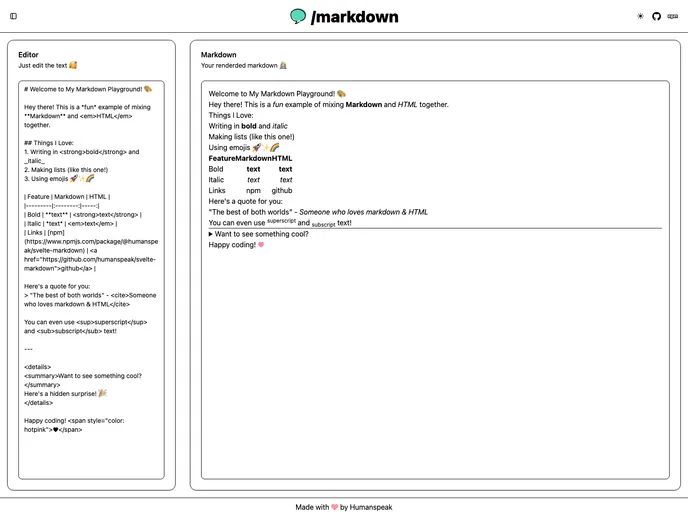
Fast, lightweight Markdown renderer component for Svelte applications with full CommonMark support
Overview
The @humanspeak/svelte-markdown package presents a powerful and customizable solution for rendering markdown within Svelte applications. Built as an advanced successor to the original svelte-markdown, this version has been enhanced by Humanspeak, Inc., providing seamless TypeScript support along with a robust feature set that caters to both developers and users alike. With an emphasis on performance, security, and flexibility, this renderer sets a new standard for working with markdown in Svelte.
The package boasts significant performance improvements, including intelligent token caching that enhances re-render speeds dramatically. This feature, combined with built-in lazy loading for images and comprehensive support for markdown syntax, positions @humanspeak/svelte-markdown as a foundational tool for modern web development.
Features
- Intelligent Token Caching: Achieves 50-200x faster re-renders using an automatic LRU cache, ensuring minimal latency for cached content.
- Smart Image Lazy Loading: Automatically loads images with smooth fade-in animations while managing errors, resulting in a 70% bandwidth reduction for image-heavy documents.
- Full Markdown Syntax Support: Employs Marked for comprehensive markdown syntax rendering, ensuring compatibility with a wide range of markdown features.
- Complete TypeScript Support: Utilizes strict typing, enhancing code quality and providing better developer experience through TypeScript.
- Customizable Component Rendering: Allows developers to customize how markdown components are rendered for greater design flexibility.
- Secure HTML Parsing: Implements HTMLParser2 for secure parsing, protecting against common web vulnerabilities.
- Accessibility Compliance: Meets WCAG 2.1 standards, ensuring that rendered content is accessible to all users.
- Enhanced Token Cleanup: Improves handling of nested content and attributes, providing better structure and readability in the output.